

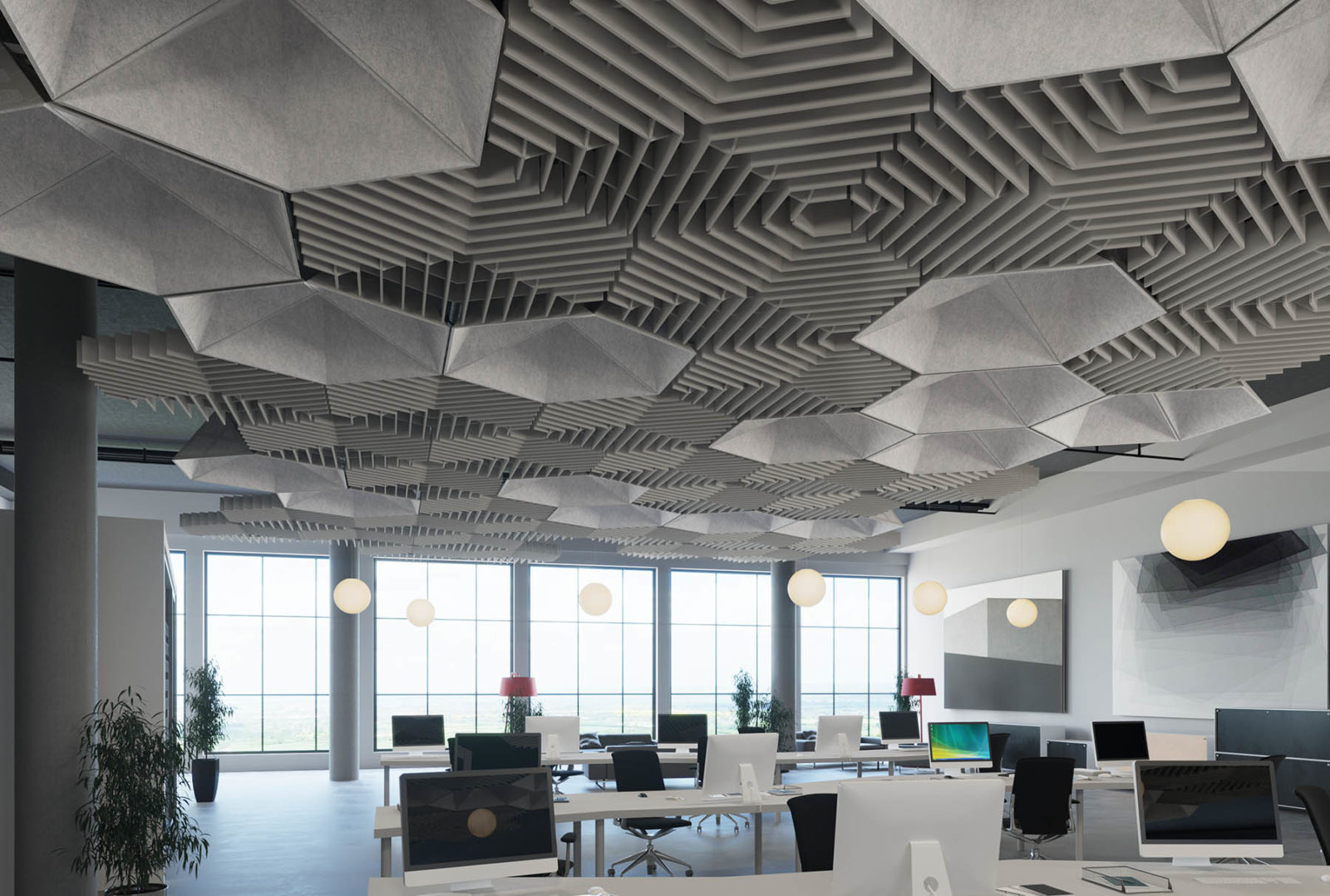
In recent years, the acoustic materials industry has undergone a major shift — from flat, two-dimensional solutions to fully modelled three-dimensional acoustic surfaces.
These new systems not only absorb sound but also diffuse it, enabling a more balanced acoustic experience and transforming interior architecture in the process.
Acoustic has become one of the pioneers integrating professionally engineered 3D acoustic systems into its product line. The result is a set of solutions that influence both acoustic performance and the visual identity of modern spaces.
Acoustic impact: the synergy of absorption and diffusion
Traditional acoustic materials relied almost exclusively on absorption. Porous materials such as mineral wool or PET panels reduce echo by dissipating sound energy.
However, contemporary interiors — especially offices, studios, concert halls and multi-purpose spaces — require not only absorption but also effective diffusion.
Diffusion:
-
scatters sound in multiple directions,
-
creates a more uniform spatial sound field,
-
improves speech intelligibility,
-
prevents “dead” acoustic zones or over-absorbed areas.
Acoustic 3D panels are engineered using non-parallel geometry, quadratic residue diffusion profiles, skyline-type structures and mathematically optimised surfaces. This ensures efficiency in both small rooms and large-volume halls.
Performance values:
-
Diffusion effectiveness: 150–4000 Hz
-
Absorption coefficient αw: 0.65–0.95 depending on geometry
-
Improved reverb control thanks to height variation in modules
Fire safety — a top requirement in architecture
Design solutions for public buildings must meet strict safety standards. Acoustic 3D systems are manufactured to comply with the highest European classifications:
-
A2-s1,d0 — mineral-based 3D constructions
-
B-s1,d0 — PET-based 3D relief systems
These ratings guarantee:
-
no contribution to flame spread,
-
minimal smoke production,
-
zero flaming droplets.
Such performance allows 3D panels to be used in:
-
schools and universities,
-
theatres and concert halls,
-
open-plan office buildings,
-
reception areas and public corridors,
-
healthcare and public sector facilities.
Architectural design: 3D as spatial scenography, not decoration
Three-dimensional acoustic formats have become a new architectural language.
Instead of treating acoustic materials as invisible technical layers, designers now use them as expressive spatial elements that define rhythm, depth, and light behaviour on surfaces.
Popular models in the Acoustic collection:
-
Wave 3D — organic flowing geometry that creates a sense of movement
-
Ribbed Depth — deep vertical structures ideal for tall spaces
-
Pyramid — a classic diffusion form used in studios and auditoriums
-
Arc Modular — curved modular blocks for parametric wall compositions
Applications:
-
large feature walls in public interiors,
-
auditorium and cinema wall treatments,
-
acoustic façades for stages,
-
meeting pods and semi-enclosed work zones,
-
recording and mixing control rooms.
In modern architecture, 3D acoustics blur the line between engineering and art.
Sustainability and ecological responsibility
Acoustic 3D panels are manufactured from:
-
recycled PET,
-
natural mineral fibres,
-
low-VOC binders.
They are fully recyclable, UV-stable and resistant to humidity — making them a long-lasting, environmentally responsible solution.
As sustainability becomes a core requirement in public procurement and large-scale building projects, Acoustic’s 3D line aligns fully with EU circular-economy goals.
Market insights: why 3D acoustics are becoming a dominant trend
According to 2025 European acoustic industry forecasts, 3D systems will soon become one of the three largest acoustic product categories, alongside PET and mineral fibre panels.
Key reasons:
-
rising architectural expectations for character-rich surfaces,
-
ability to combine absorption and diffusion in one product,
-
scalability for both small and large interiors,
-
reliable safety certification for public buildings,
-
BIМ-friendly geometry and performance modelling.
3D acoustics are no longer an optional premium feature — they are becoming a new standard in public, commercial and hybrid workspaces.
The Acoustic 3D series represents a fusion of scientific acoustic engineering, safety, sustainable manufacturing and architectural expression.
It empowers designers to create interiors that sound as good as they look, setting a new benchmark for modern acoustic design.