

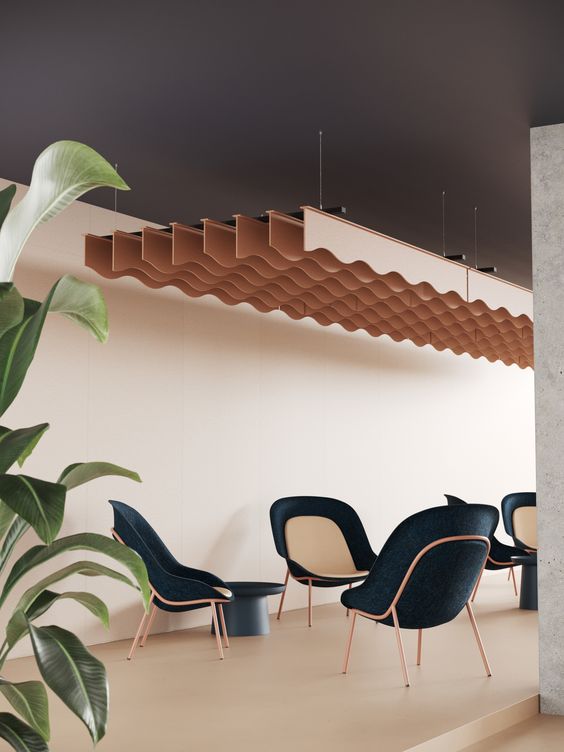
In recent years, the global acoustic solutions market has undergone a significant shift. More architects and interior designers now choose PET (polyethylene terephthalate) acoustic panels as the most modern, sustainable and versatile method of controlling sound.
Made from recycled plastic bottles, PET has reshaped the philosophy of sustainable design — offering high acoustic performance without compromising environmental responsibility.
The Acoustic PET line is not merely a set of panels; it is a comprehensive design system enabling safe, aesthetic and highly adaptive acoustic environments.
Sustainability: recycled materials and circular-design principles
The greatest advantage of PET panels is their sustainability. Each panel is made from post-consumer plastic waste, reducing pollution and supporting circular production cycles.
Acoustic PET sustainability metrics:
-
up to 60% recycled bottle content,
-
low CO₂ manufacturing footprint,
-
long service life (10–20 years),
-
fully recyclable after use,
-
low-VOC binders for healthier interiors.
PET solutions allow designers to significantly reduce a project’s environmental impact without sacrificing functionality.
Sound absorption: why PET outperforms many traditional alternatives
PET is composed of thousands of interconnected microfibres that create a dense network of sound-absorbing pores.
Acoustic PET performance values:
-
NRC / αw: 0.85–1.00,
-
excellent absorption in the 500–4000 Hz range,
-
suitable for walls, ceilings, suspended shapes and 3D forms,
-
can be layered to enhance low-frequency performance.
This makes PET ideal for:
-
offices,
-
commercial spaces,
-
schools and childcare facilities,
-
residential interiors,
-
restaurants and public areas.
Fire safety: high-performance classifications
Because PET panels are widely used in public interiors, fire safety certification is essential.
Acoustic PET panels meet:
-
B-s1,d0 classification — one of the safest ratings for polymer-based materials,
-
s1 minimal smoke production,
-
d0 no flaming droplets.
This ensures suitability for education, healthcare, public buildings and commercial interiors.
Design potential: limitless creative freedom
One of the greatest strengths of PET is its design versatility. Acoustic PET panels can be:
-
cut,
-
CNC-shaped,
-
layered,
-
curved,
-
perforated.
Popular design formats:
-
3D sculpted surfaces,
-
geometric arrays (hexagon, grid, arc),
-
perforated patterns,
-
large color-zoned acoustic fields,
-
hanging clouds and free-form elements.
PET becomes not only an acoustic tool, but also a visual identity element of interior architecture.
Installation: fast, clean, adaptable
PET provides simple installation options, which significantly lowers project complexity and costs.
Mounting methods include:
-
adhesive systems,
-
magnetic plates,
-
concealed mounting profiles,
-
modular frames,
-
suspended cable structures.
This makes PET ideal for quick renovations, dynamic office layouts and design changes.
Market insights: why PET is the fastest-growing segment
According to European Acoustic Association reports, PET acoustic products have seen over 30% growth in recent years.
Key drivers:
-
sustainability as a top architectural priority,
-
unmatched cost–performance ratio,
-
immense design flexibility,
-
rapid installation and lower labor costs,
-
excellent fire and safety certification.
PET is rapidly becoming the new standard in acoustic architecture.
The Acoustic PET series represents a perfect balance of acoustic efficiency, sustainable material science, safety and modern design.
It is one of the most future-ready solutions for contemporary architecture — enabling spaces that are functional, responsible and visually compelling.